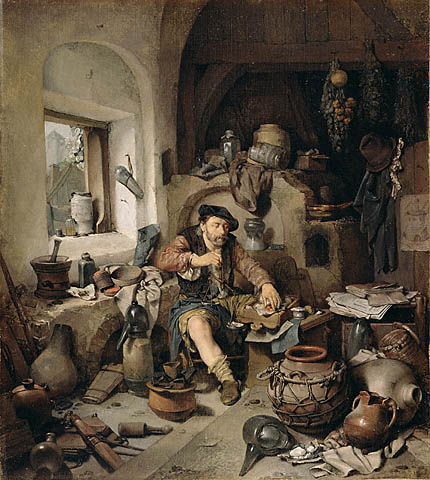
Baroque era painter, Cornelis Bega, was born in 1631. He was the son of a Mannerist painter's daughter and a goldsmith. He was born in Haarlem, Netherlands. Cornelis was the pupil of genre painter, Adriaen van Ostade. His earlier paintings show his teacher's influence by depicting dark, freely executed objects, but with Bega's touch, he gave them more of a psychological insight. After traveling through Germany, Switzerland, and France, in 1654 he returned to Haarlem to join the Guild of St. Luke. It is rumored that his life was cut short, in 1664, by the plague.
Cornelis often liked to depict domestic scenes, such as taverns, and villages with average characters. He liked to depict alchemists, mothers, and even prostitutes. From 1660 to his death, his paintings became filled with color and seemed less cluttered. The characters in his paintings started to decrease in numbers and the art work became more expressive. He also started to pay attention to close detail, such as he did in The Alchemist. He also liked to sketch and make counterproofs in different materials.
In later years, many people were influence by Bega's style and even used some of his characters. He had a significant influence on dutch artist, Jan Steen.
Some other well known art works that Bega created are The Lute Player,
and The Duet.