IN CONCLUSION...

The more I look at the picture I chose, the more I find myself wondering the exact feelings that Cornelis felt when creating this piece of art work. I want to ask so many questions like, "why did you choose this subject?", or, "why these colors?" So many questions still go unanswered but I feel that the mysteriousness of it all, makes the painting beautiful.


Looking through his other art works, while doing my research, has brought me closer to Bega. I find myself picking at each picture and noticing as much detail as possible. As the genre scenes depict the life that Bega put himself in, or even the lives that he saw around him, I feel that I am entering into a whole new world. The alchemist steadies his hand and measures the ingredients for gold and I stare in silence, trying not to make too much noise to disturb the man.


After learning about his style and some of his life, I'm very happy with the choice I've made; with the artist and the painting.

CORNELIS BEGA


Baroque era painter, Cornelis Bega, was born in 1631. He was the son of a Mannerist painter's daughter and a goldsmith. He was born in Haarlem, Netherlands. Cornelis was the pupil of genre painter, Adriaen van Ostade. His earlier paintings show his teacher's influence by depicting dark, freely executed objects, but with Bega's touch, he gave them more of a psychological insight. After traveling through Germany, Switzerland, and France, in 1654 he returned to Haarlem to join the Guild of St. Luke. It is rumored that his life was cut short, in 1664, by the plague.

Cornelis often liked to depict domestic scenes, such as taverns, and villages with average characters. He liked to depict alchemists, mothers, and even prostitutes. From 1660 to his death, his paintings became filled with color and seemed less cluttered. The characters in his paintings started to decrease in numbers and the art work became more expressive. He also started to pay attention to close detail, such as he did in The Alchemist. He also liked to sketch and make counterproofs in different materials.


In later years, many people were influence by Bega's style and even used some of his characters. He had a significant influence on dutch artist, Jan Steen.

Some other well known art works that Bega created are The Lute Player,


and The Duet.


ART WORK: THE ALCHEMIST

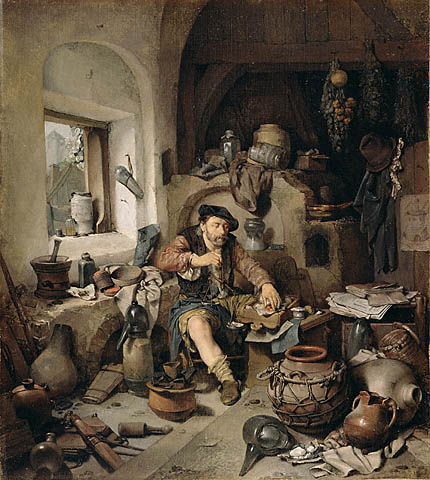
The Alchemist was painted by Cornelis Bega. It was made in 1663 and it is oil on panel. The dimensions are 14 x 12 1/2 in.

Upon looking at this image at the Getty, I found myself rather astonished by the veracity of the man. He seems so intent on making his experiment and looking with his watchful eye for any sudden changes that might surprise him. I felt that the chaotic space that he was put in not only showed his willingness for the subject of alchemy but almost for an obsession. He has become so enveloped in his experiments that he no longer cares for his surroundings. The small room is left in a chaotic mess and the only thing that receives his attention is the experiment in his hand. The dark colors made me feel almost as if the artist was saying, "Throughout the night the man worked and strived for an answer; it was something he was longing for with all of his heart!"

In the picture, the artist is surrounded by paraphernalia. He holds a scale while measuring the ingredients to make gold. By the 17th century, alchemy was not something that was looked upon as something of worth. The practitioners were made fun of and deemed as useless. This picture was painted as a genre scene. The artist made this to comment on the time that was being wasted on hollow pursuits. The artist, Cornelis Bega, was very good with naturalistic details and with this he showed the textures and surfaces perfectly with the cracked pottery and other clay objects in the room. The imaginary source of light that pours through the window gives a sense of warmth towards the man and his surroundings.

VISIT TO THE J. PAUL GETTY MUSEUM

I wake up on a cool Thursday morning filled with excitement on the fact that I would be visiting the Getty Museum that day. I find my way through a quick and fulfilling breakfast, and head out on the freeway towards my destination. After of about an hour drive, we pull up to the Getty parking lot and watch in amazement of our destination. The Getty never seems to disappoint us when it comes to candy for the eyes. As we walk through the line formations to get into the tram that leads to the museum, I get tiny butterflies because of the experience. Somehow, the tram always makes me very nervous, especially since the height is overwhelming as it leads us up the hill and to the museum.
We finally get our chance to get into the tram and make our way up the beautiful hill. The picturesque city of Los Angeles waits below us and it watches us ascend into a world of art and wonder. Our stop is just at the very bottom of the stairs that leads up to the museum.

We walk out with wide eyes at the beauty of it all. I immediately want to run up the stairs and talk a brief walk through their garden, and this is exactly what I do.


After my walk through the garden, I made my way back up to the cafe and decided which route I would take through all the wings.


As I started making my way through the wings, I felt alive. I'm not an art major but there is something that it does to me. I am a writer, so seeing something as beautiful as the works of art that were displayed before me, became sort of an inspiration for a new short story/poem. All of this halted when I walked up to a painting that seemed to stun me with mysteriousness and magnificence. This painting was called The Alchemist. In my next post, I will go on telling about the picture and showing its features of greatness. I was stuck staring at the picture for a while before I had the will to go on and look at other pieces of art work.


The whole day was filled went on, more or less, in this manner. I almost felt sadness when I had to board the tram to head back home, but I knew I was going home with more of a perspective on the art world. The garden had the natural beauty, while the art work inside the museum's wings, captured the natural beauty in such a picturesque way. It was almost as if I was looking into two different worlds as I was glancing outside and into the world that was photographed/painted/drawn or even sculpted by the artists.
I watch as kids learned the different themes and textures of the art works and I watched as the tourists crowded around their tour guide to see the special art work they were pointing out.

Overall the day went rather well and I found myself loving the Getty just as I always have since I was a kid in elementary school, looking forward to seeing all the "pretty pictures."